
Table of Contents
- How to Furnish Rental Properties Cheaply: Start With a Budget That Survives Turnover
- Set a Furnishing Budget by Rental Type
- How Much Does It Cost to Furnish a Rental Property?
- Furniture Essentials for a Furnished Rental: What Tenants Actually Need
- Furnishing a Rental Property Room by Room
- Short-Term Rental Furnishing Checklist for Fast Turnovers
- Buying Second-Hand and Scratch-and-Dent Without Getting Burned
- Total Cost of Ownership: Why Cheap Upfront Can Cost More Later
- Frequently Asked Questions
Last Updated: October 14, 2026
How to Furnish Rental Properties Cheaply: Start With a Budget That Survives Turnover
Learning how to furnish rental properties cheaply starts with one number: the total you can spend before the unit turns over again.
Furnishing a rental property means outfitting a unit with the furniture, appliances, and soft goods a tenant needs, at a cost that still leaves the rental profitable.
Below, we break down budget benchmarks by rental type, what tenants expect in each room, and where second-hand and scratch-and-dent buying pays off.
Set a Furnishing Budget by Rental Type
The right furnishing budget depends on how long each tenant stays. A short-term rental turns over weekly and needs hotel-grade durability; a twelve-month lease can tolerate a plainer setup.
| Rental Type | Typical Turnover | Budget Priority | What Drives Cost |
|---|---|---|---|
| Short-term (nightly) | Weekly | Durability, guest appeal | Full furnishing, restocking |
| Mid-term (monthly) | Every 1-3 months | Flexibility, multifunctional pieces | Moderate turnover |
| Long-term (annual) | Yearly | Functionality, low maintenance | Fewer replacements |
For a nightly rental, every item must survive hundreds of guests. For an annual lease, spend less per item because the tenant absorbs most wear. Decide which model you run before you buy anything.
How Much Does It Cost to Furnish a Rental Property?
There is no single national figure for how much it costs to furnish a rental property, because cost swings with unit size, rental model, and what you already own.
Start by setting a per-room ceiling, total it, then subtract a reserve for replacements. A common pattern is to cap the whole furnishing spend at a share of expected annual rent, then work backward into per-room limits.
| Room | Typical Range (per unit) | Core Items | Notes |
|---|---|---|---|
| Bedroom (each) | $400-$900 | Bed frame, mattress, dresser, nightstand | Mattress is the biggest single line |
| Living room | $500-$1,200 | Sofa or sofa bed, coffee table, TV, lamp | Sofa bed adds cost but adds a sleeping space |
| Dining area | $150-$450 | Table, four chairs | Smaller units may use a counter-height set |
| Kitchenware and small appliances | $150-$400 | Cookware, dishes, utensils, microwave, coffee maker | Buy spares of high-break items |
| Soft goods | $100-$300 | Linens, mattress covers, towels, curtains | Washable and replaceable |
These are for one unit and assume a mix of new budget items and second-hand pieces.
A practical approach many landlords use:
- List every room and the essentials it needs (we cover these below).
- Assign each item a ceiling price you will not exceed.
- Total the ceilings to get your furnishing budget.
- Set aside a replacement reserve for the first year.
- Shop only against the list, not against what looks good in a showroom.
Price your replacement reserve before you buy a single item. Landlords who skip it end up replacing a mattress or sofa out of pocket mid-lease, which is exactly the cost the budget was meant to absorb.
That reserve separates a furnishing budget from a shopping spree. When a tenant damages a coffee table or a mattress sags, you replace it from a fund you already set aside, not from next month’s cash flow.
A Prioritized Cart for Different Property Sizes
If the budget is tight, buy in priority order rather than room order. The cart below assumes a one-bedroom and a three-bedroom unit, listing what to buy first when cash is limited.
| Priority | One-bedroom unit | Three-bedroom unit |
|---|---|---|
| 1 | Mattress and bed frame | Mattresses and frames for all bedrooms |
| 2 | Sofa or sofa bed | Sofa plus seating for common area |
| 3 | Dining table and two to four chairs | Dining table and four to six chairs |
| 4 | Dresser and nightstand | Dresser and nightstand per bedroom |
| 5 | Kitchenware and small appliances | Kitchenware and small appliances |
| 6 | Linens, covers, towels | Linens, covers, towels per bed |
| 7 | TV and lamps | TV and lamps per room |
Buy down the list until the money runs out. Everything above the line is livable; everything below it can wait for the next turnover or tenant request. This is how you furnish a rental cheaply without leaving a unit that feels unfinished.
Where the Money Actually Goes
Two line items eat most of a furnishing budget: mattresses and seating. A mattress is the item tenants notice most and the one most likely to be replaced early, so buy the best your budget allows and protect it with a washable cover.
Appliances are a separate calculation. If the unit already has a refrigerator, range, and washer and dryer, you are furnishing, not equipping. If not, appliance cost can exceed furniture cost, and scratch-and-dent sourcing becomes the biggest lever on the total.
Furniture Essentials for a Furnished Rental: What Tenants Actually Need
Furniture essentials for a furnished rental are the items a tenant would otherwise buy themselves: a bed, somewhere to sit, a table to eat at, and working appliances. Skip extras that raise your cost without raising rent.
Bedroom, Living Room, and Dining Area Essentials
Bedroom: bed frame, mattress, dresser or closet storage, and a nightstand if space allows.
Living room: sofa or sofa bed, coffee table, and a television if the unit is marketed as furnished. A sofa bed earns its keep in short-term rentals by doubling as sleeping space.
Dining area: dining table and chairs sized to the unit. A table that seats four fits most one-bedroom and two-bedroom units without crowding the room.
Buying a full matching set for every room is the most common budget mistake. Tenants care about function, not whether the nightstand matches the dresser. Mixing pieces from different sources saves money and rarely shows.
Furnishing a Rental Property Room by Room
Furnishing a rental property room by room keeps you from overspending in one space and running short in another. Work through the highest-use rooms first, and buy for durability where tenants spend the most time.
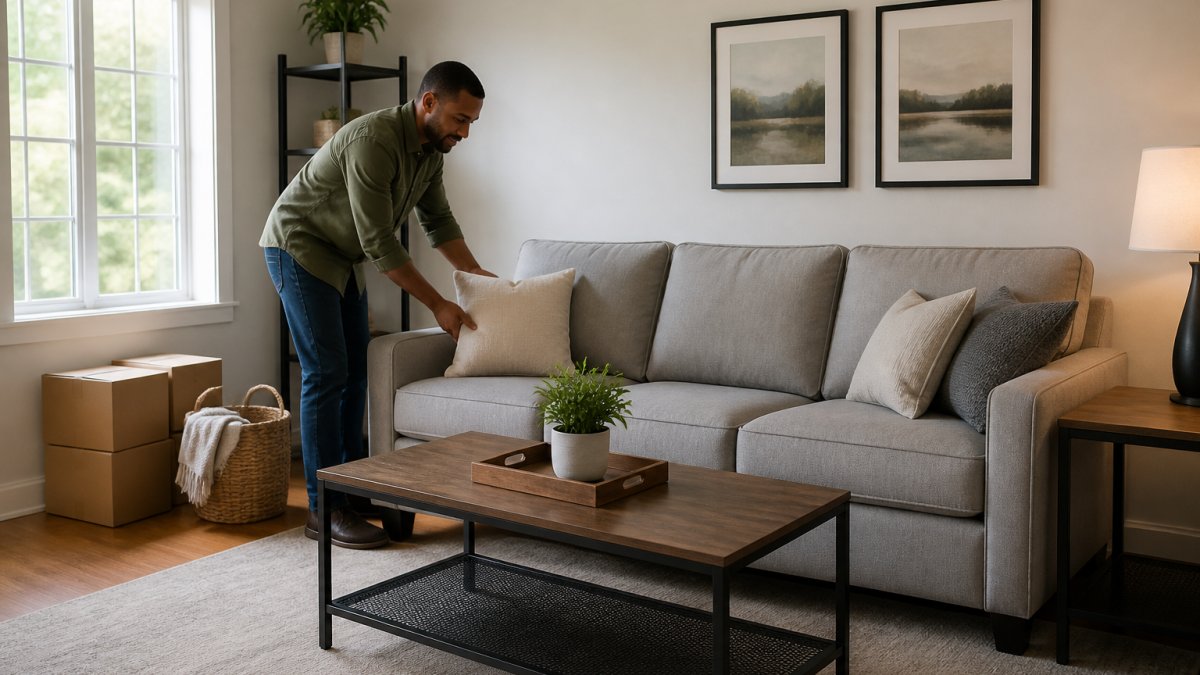
Living Room: The Highest-Use Space
The living room takes more daily wear than any other room, so it deserves the largest share of your furniture budget. In short-term rentals, add a sofa bed to sleep extra guests without a second bedroom.
Choose fabrics that clean easily. Light-colored upholstery shows every stain; a mid-tone or patterned fabric hides wear between turnovers and stretches the time before you replace the piece.
Dining Area and Kitchen Overlap
In smaller units, the dining table often doubles as a workspace, so pick a surface that survives daily use. A simple table with four chairs handles most rentals. If the kitchen has no counter seating, the dining table is the only place to eat, making it non-negotiable.
Short-Term Rental Furnishing Checklist for Fast Turnovers
A short-term rental furnishing checklist must cover everything a guest needs on arrival, because a missing item means a bad review. Fast turnovers reward durable, replaceable items over fragile ones.
- Bed frames and mattresses for every sleeping space
- Sofa or sofa bed in the living room
- Dining table and chairs
Buy two of anything a guest is likely to break or stain: sheets, pillowcases, and small appliances that see daily use. A spare on the shelf beats an emergency shopping trip between guests.
How the Checklist Changes by Rental Model
The same unit furnished for nightly guests will not work for a twelve-month lease, and vice versa. Inventory needs differ by how long the tenant stays.
| Item | Short-term (nightly) | Mid-term (monthly) | Long-term (annual) |
|---|---|---|---|
| Sofa bed | Strongly recommended | Useful | Optional |
| Full kitchenware set | Required | Required | Basic set |
| Spare linens on site | Two sets per bed | One spare set | One set |
| Decor and wall art | Expected | Nice to have | Minimal |
| Luggage storage | Expected | Sometimes | Not needed |
| Desk or workspace | Often expected | Often expected | Tenant supplies |
| Durability grade | Hotel-grade | Mid-grade | Standard |
A short-term unit needs hotel-grade durability because every item survives hundreds of guests. A mid-term unit can tolerate mid-grade furniture because turnover is slower. A long-term unit can use standard furniture because the tenant absorbs most of the wear.
Safety, Accessibility, and Compliance for Furnished Units
Budget-focused guides rarely mention safety, but a furnished rental carries risks an empty one does not. Furniture that tips, cords that trip, and materials that burn are avoidable problems, and addressing them costs little.
- Anchor tall dressers, bookcases, and televisions to the wall (AnchorIt.gov). Tip-over incidents are a known hazard, and anchoring kits are inexpensive.
- Choose furniture that meets applicable flammability standards for upholstered items, and check labels on mattresses and soft goods.
- Keep a working smoke detector and carbon monoxide detector in the unit, and test them between guests.
Safety equipment and anchoring are not optional upgrades. A single tip-over or fire incident can cost far more than the entire furnishing budget, and some insurers require specific protections before they will cover a rental.
Turnover Logistics That Protect the Furniture
Fast turnovers are hard on furniture, and how you set up the unit determines how long items last. Keep a labeled bin of spare linens, light bulbs, and small appliances so a cleaner can swap a stained item without a shopping trip. Use washable slipcovers on the sofa and chairs so a spill becomes a laundry load instead of a replacement.
Buying Second-Hand and Scratch-and-Dent Without Getting Burned
Buying second-hand furniture and scratch-and-dent appliances is the fastest way to cut furnishing costs, provided you inspect before you pay. The savings are real, but so are the traps: hidden structural damage, missing parts, and appliances that fail within months.
What to check before you buy used:
- Sit on every sofa and press on every mattress to feel for sagging or broken springs.
- Open and close every drawer and door to test the hardware.
- Plug in appliances and run them through a full cycle before purchase.
Scratch-and-dent appliances are a different calculation. A dented refrigerator door or scratched washer works exactly like a new one; the damage is cosmetic.
A scratch-and-dent appliance with a cosmetic flaw performs the same job as a new one. For a rental unit, that is money saved with no downside to the tenant.
Total Cost of Ownership: Why Cheap Upfront Can Cost More Later
The cheapest item on the shelf is rarely the cheapest over five years.
Furniture and Appliance 4less offers payment options through Acima, Koalafi, and Snap, letting landlords spread a furnishing purchase across monthly payments instead of paying upfront.
We also handle local same-week delivery and professional setup, plus old-product haul-away, so you are not stuck moving a replaced sofa to the curb yourself.
Frequently Asked Questions
How much money should I save to furnish a rental property?
A common starting point is 1-3% of the property’s value for a full furnishing, though the real number depends on unit size, rental type, and whether you’re targeting short-term or monthly tenants. A studio needs far less than a three-bedroom. Build your budget around a furnishing checklist covering each room, then price out mid-range and second-hand options side by side before committing.
What furniture should I buy first for a rental property?
Start with the items tenants cannot live without: a bed and mattress, a sofa or sofa bed, a dining table with chairs, and a dresser or closet storage. These are the furniture essentials for a furnished rental that drive bookings and lease signings. Appliances like a refrigerator, stove, and washer come next if they aren’t already in the unit. Decorative extras can wait until the core pieces are in place.
Is it cheaper to buy furniture or rent it for a rental property?
Buying usually wins if you plan to keep the unit furnished for more than a year or two. Renting furniture makes sense for very short leases, staging, or when you need flexibility to swap pieces. Run the math on total cost of ownership: purchase price plus delivery, setup, and replacement versus monthly rental fees over your expected holding period.
How do you choose durable furniture for a rental property?
Look for solid frames, stain-resistant upholstery, and finishes that wipe clean. Multifunctional furniture like a sofa bed or day bed earns its keep in smaller units. Avoid particleboard pieces that sag under daily use. Scratch-and-dent appliances can be a smart buy because the damage is cosmetic, not mechanical, and they typically cost less while working the same as new.
How can you furnish a short-term rental without overspending?
Focus on guest needs first: comfortable sleeping, seating, and a functional kitchen and dining area. A short-term rental furnishing checklist should include bedding, towels, basic cookware, and a television, but skip high-end decor that guests won’t notice. Buy second-hand for solid wood pieces, use budget-friendly financing for appliances, and keep a small reserve for replacements after heavy turnover.
What is considered furnished in a rental property?
A furnished rental typically includes a bed, sofa, dining table and chairs, dresser, and basic appliances like a refrigerator and stove. Short-term and vacation rentals usually add cookware, linens, a television, and sometimes a coffee maker. Monthly rental units may offer less. Check your lease language so tenant expectations match what you actually provide.
Furnishing a rental on a tight budget is a balancing act between upfront cost and how long each item lasts. When you are ready to outfit a unit without overpaying, Furniture and Appliance 4less can help with flexible financing through Acima, Koalafi, and Snap, local same-week delivery, and professional setup with old-product haul-away. Contact Us to build a furnishing package that fits your budget and your turnover schedule.