
Last Updated: November 16, 2026
Quick Summary
A power reclining sofa uses an electric motor and control button to move the footrest and backrest, while a manual recliner sofa uses a lever or pull handle worked with your own body weight and arm strength. Choose power for effortless, precise adjustment and limited mobility; choose manual for a simpler, lower-cost machine with fewer parts to break.
- Power recliners need a nearby grounded outlet, so furniture placement is less flexible.
- Manual sofas cost less up front and can go anywhere in the room, outlet or not.
- A power sofa used several times a day adds only a few dollars a year to your electric bill.
- Many power sofas accept an optional battery pack that keeps the seat operable during an outage.
- If the main sitter has mobility concerns, power is the safer pick.
Table of Contents
- Power vs Manual Reclining Sofa: The Core Differences
- Power Reclining Sofa Pros and Cons
- Manual Reclining Sofa Pros and Cons
- Power Recliner vs Manual Cost: What Drives the Price Gap
- Power Recliner Sofa Outlet Requirements and Room Planning
- Reliability, Repairs, and Power Outage Backup
- How to Choose the Right Reclining Sofa for Your Household
- Try Both Reclining Sofas in Person Before You Buy
- Frequently Asked Questions
Power vs Manual Reclining Sofa: The Core Differences
The core difference between a power reclining sofa and a manual recliner sofa comes down to one part: how the reclining mechanism moves. A power reclining sofa uses an electric motor, wired to a control button or switch, to push the footrest out and tilt the backrest. A manual recliner sofa uses a lever or pull handle that you work with your own body weight and arm strength.
That single mechanical difference shapes everything else: cost, ease of use, repair needs, and even where the sofa can go in your room. The answer usually depends less on budget than on who will sit in the seat every day.
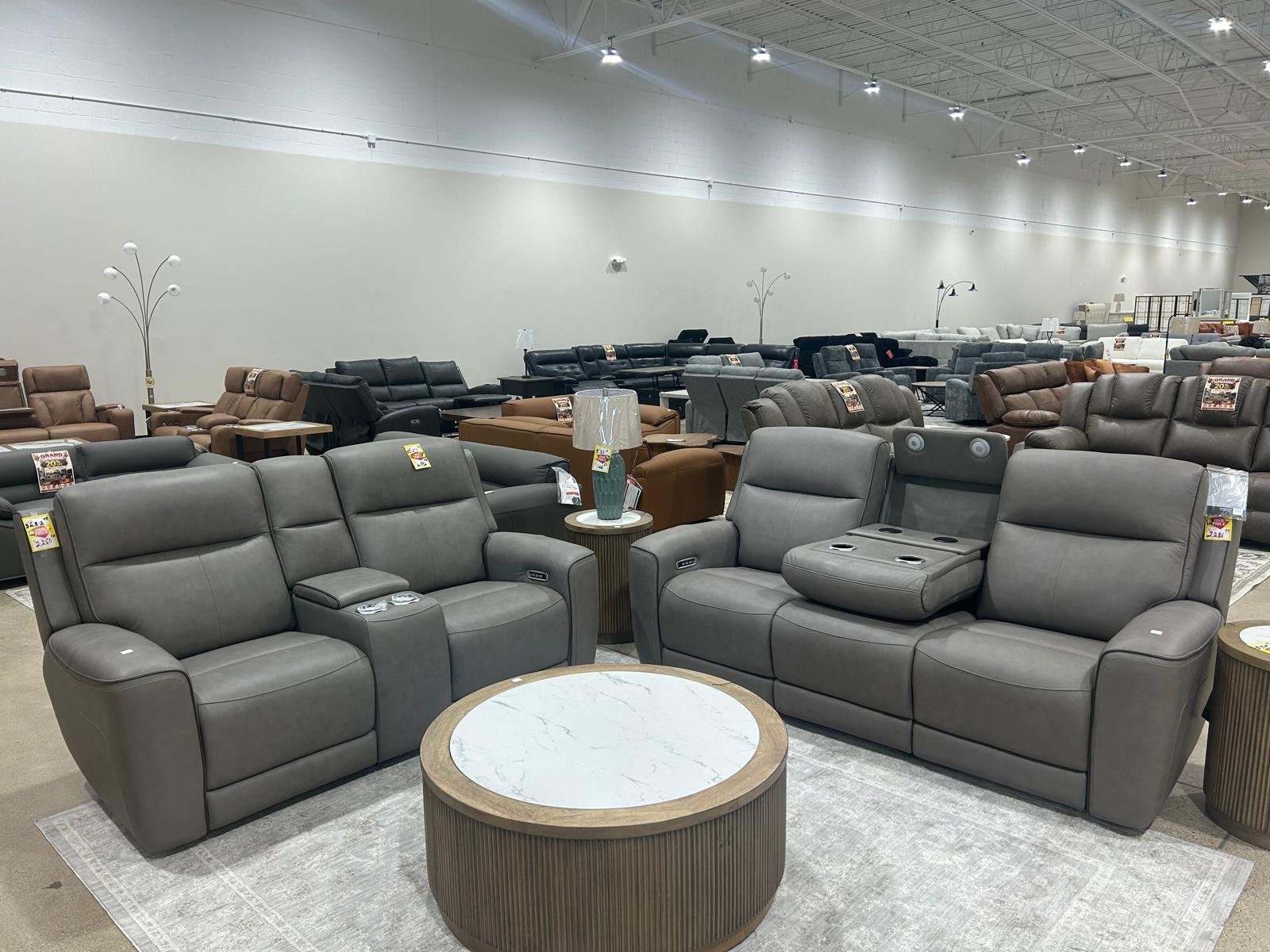
Here is the short version. Power gives you smooth, controlled adjustment with light finger pressure, but it needs an outlet and a motor that can fail. Manual gives you a simpler machine with fewer parts to break, but it asks more of your body. Neither is “better” in the abstract. The right pick is the one that matches your household.
Power Reclining Sofa Pros and Cons
Power reclining sofa pros center on effortless, precise adjustment. Press a button and the footrest glides out while the backrest eases down, and you can stop at any reclining position in between. For anyone with limited mobility, joint pain, or back posture concerns, that matters: no pushing, no shoving, no bracing your legs to close the footrest.
The cons are real too. A power recliner needs a nearby electrical outlet and a power cord, so furniture placement is less flexible. Motors and control buttons add parts that can wear out. And when the power goes out, the seat stays where it is until power returns or a battery backup kicks in.
- Best for: older adults, anyone with joint pain or limited mobility, households that want one-touch adjustability
- Watch for: outlet access, motor replacement cost down the road, and whether the model offers battery backup
- Skip if: your room has no convenient outlet or you want the simplest possible machine
If you want to see a concrete example of what power looks like in a real sofa, browse the Boxmere power reclining sofa to compare its leather upholstery and control layout against the manual option below.
Manual Reclining Sofa Pros and Cons
Manual reclining sofa pros start with simplicity. A lever or pull handle connects to a spring-and-latch reclining mechanism with no motor, no wiring, and no power supply. Fewer parts means fewer failures, and repairs are usually cheaper when something does wear out. Manual sofas also cost less up front and can go anywhere in the room, outlet or not.
The trade-off is physical effort. You push back against the backrest and use your legs to extend or retract the footrest. For most healthy adults that is easy. For someone recovering from surgery, living with arthritis, or shopping for an elderly parent, it can be the deciding factor.
- Best for: budget-conscious buyers, guest rooms, and households with no mobility concerns
- Watch for: the lever position, since some sit low and require a firm reach
- Skip if: the primary sitter has limited mobility or joint pain
To see the manual version in a real set, look at the Moreau Place manual reclining sofa and note how the side lever and neutral fabric fit a family room.
Power Recliner vs Manual Cost: What Drives the Price Gap
Power recliner vs manual cost comes down to the motor, the wiring, and the control hardware. A power model carries an electric motor, a transformer, control buttons, and the labor to assemble and test all of it.
Most side-by-side comparisons stop at the sticker price. The more useful comparison is total cost of ownership across the life of the sofa, because the purchase price is only the first line item.
Electricity. A single recliner motor draws roughly 1 to 2 amps at 120 volts while it is moving, and it only runs for a few seconds per cycle. In practice, a power sofa used several times a day adds only a few dollars a year to a household electric bill, it is not a meaningful ongoing cost. The real electricity concern is not the bill; it is outlet access and cord management, covered in the room-planning section below.
Battery backup. Many power sofas accept an optional battery pack that keeps the seat operable during an outage.
Motor and control replacement. Motors, hand controls, and transformers are the parts most likely to need service on a power sofa. Replacement cost depends heavily on the manufacturer and whether the part is still in production.
Warranty terms. Read the warranty by component, not as a single number. Frames commonly carry longer coverage than motors and electronics, and labor coverage is often shorter than parts coverage.
Repairability. Manual mechanisms are mechanical and widely serviceable; a lever or cable can often be replaced without a technician.
| Cost factor | Power Reclining Sofa | Manual Recliner Sofa |
|---|---|---|
| Up-front price | Higher | Lower |
| Electricity use | Small ongoing draw, a few dollars a year | None |
| Battery backup | Optional purchase plus battery replacement | Not applicable |
| Most likely repair | Motor, hand control, transformer | Lever, cable, spring-and-latch mechanism |
| Technician needed | Often, for diagnosis and motor/control replacement | Usually not for lever or cable |
| Warranty focus | Frame, motor, electronics, labor, read each separately | Frame and mechanism |
| Long-term value | Good with light use and available parts | Strong, fewer parts and simpler repairs |
We do not publish fixed prices here because cost depends on size, configuration, and current promotions. For current pricing on a power sectional, check the Hewitt leather power reclining sectional to see how features map to price.
Power Recliner Sofa Outlet Requirements and Room Planning
Power recliner sofa outlet requirements are simple but easy to overlook. Each power seat needs access to a standard grounded electrical outlet, usually through a power cord that runs from the back or underside of the sofa. Plan for a gap behind the sofa so the cord is not pinched, and avoid running cords across walkways where someone could trip.
Room planning goes beyond the outlet. A reclining sofa needs clearance behind it for the backrest to tilt and space in front for the footrest to extend. Measure the full reclined depth, not just the closed footprint, before you buy. A sofa that fits the wall may not fit the room once it reclines.
- Confirm at least one grounded outlet near the sofa’s final position
- Leave several inches behind the sofa for the cord and backrest travel
- Measure reclined depth plus walking space in front
- Consider a power strip with surge protection for multiple seats
For a dual power set built with this layout in mind, see the Beryton dual power leather reclining sofa.
Reliability, Repairs, and Power Outage Backup
Reliability favors the manual recliner on pure part count. No motor means no motor failure, and a lever-and-spring mechanism is a known, repairable design.
The more important question for most households is what happens when the power goes out. A powered sofa holds its last position until power returns, which can leave the footrest extended and the seat reclined.
Battery backup pack. Many power recliners accept an optional battery pack that plugs into the sofa’s control system and lets you operate the seat during an outage.
Manual release or emergency return. Some power mechanisms include a manual release that lets you return the seat to upright without power.
Unplug and wait, or use a portable power station. If the sofa has no backup and no manual release, the seat stays put until power returns.
On repairs, the decision usually comes down to parts availability.
Warranty coverage varies by manufacturer, so read the terms on the frame, the motor, and the mechanism separately. Frames often carry longer coverage than motors or electronics, and labor coverage is often shorter than parts coverage.
How to Choose the Right Reclining Sofa for Your Household
Choosing comes down to matching the mechanism to the people and the room. Answer these questions honestly:
- Who sits in the sofa most, and do they have limited mobility or joint pain?
- Is there a grounded outlet within reach of the sofa’s final spot?
- What is your up-front budget versus your comfort with future repair costs?
- Does the room have space for the full reclined depth?
- Do you need battery backup for outages?
If the main sitter has mobility concerns, power is the safer pick. If the sofa is for a guest room or a healthy household on a tight budget, manual delivers strong long-term value. Families furnishing a full room can also browse living room furniture sets for families to match a recliner to the rest of the space.
Try Both Reclining Sofas in Person Before You Buy
Specs tell you part of the story. Sitting tells you the rest. The lever height, the button position, the firmness of the footrest, and the feel of the backrest at full recline all vary by model, and none of that shows up on a spec sheet. Spend a few minutes in each seat, extend and retract it fully, and picture the person who will use it most.
Furniture and Appliance 4less offers flexible financing options through Acima, Koalafi, and Snap, local same-week delivery, professional setup and inspection services, and old-product haul-away.
The best reclining sofa is the one that fits how your household actually lives. Come sit in both, ask us about power and manual options, and choose with confidence. Get started with Furniture and Appliance 4less and furnish your living room with comfort that lasts.
Frequently Asked Questions
What is the difference between a power reclining sofa and a manual recliner sofa?
A power reclining sofa uses an electric motor to move the footrest and backrest, controlled by buttons on the armrest or a wired remote. A manual recliner sofa uses a lever or pull handle and your own body weight to release and push the mechanism into position. The power version needs an electrical outlet and does the work for you; the manual version is simpler, has no cords, and typically costs less. Both deliver the same basic reclining positions.
Do power reclining sofas need to be plugged in?
Yes. Every power reclining sofa needs a nearby electrical outlet, usually within reach of the power cord, and many models draw power only while the motor is running. Check the outlet requirements before delivery: you may need a dedicated outlet or a surge protector, and cords should not run across walkways. Battery backup kits are available for some models so the sofa can still close during a power outage.
Which type of reclining sofa is more reliable and easier to repair?
Manual recliner sofas have fewer parts, so there is less to fail and repairs usually involve the lever, cable, or mechanism rather than electronics. Power reclining sofas add a motor, wiring, and control buttons, which means more potential failure points, but replacement motors and control parts are widely available. Ask about warranty coverage on the motor and mechanism before buying, and confirm whether replacement parts can be ordered.
Is a power reclining sofa worth the extra cost?
It depends on who uses the sofa. For people with limited mobility, joint pain, or back posture concerns, the smooth powered adjustment and easy control buttons often justify the higher purchase price. For households that rarely recline or want the lowest upfront cost and simplest maintenance, a manual recliner sofa is the practical pick. Factor in electricity, possible battery backup, and repair costs over the sofa’s lifespan, not just the sticker price.
